
How to choose your clock to match your décor

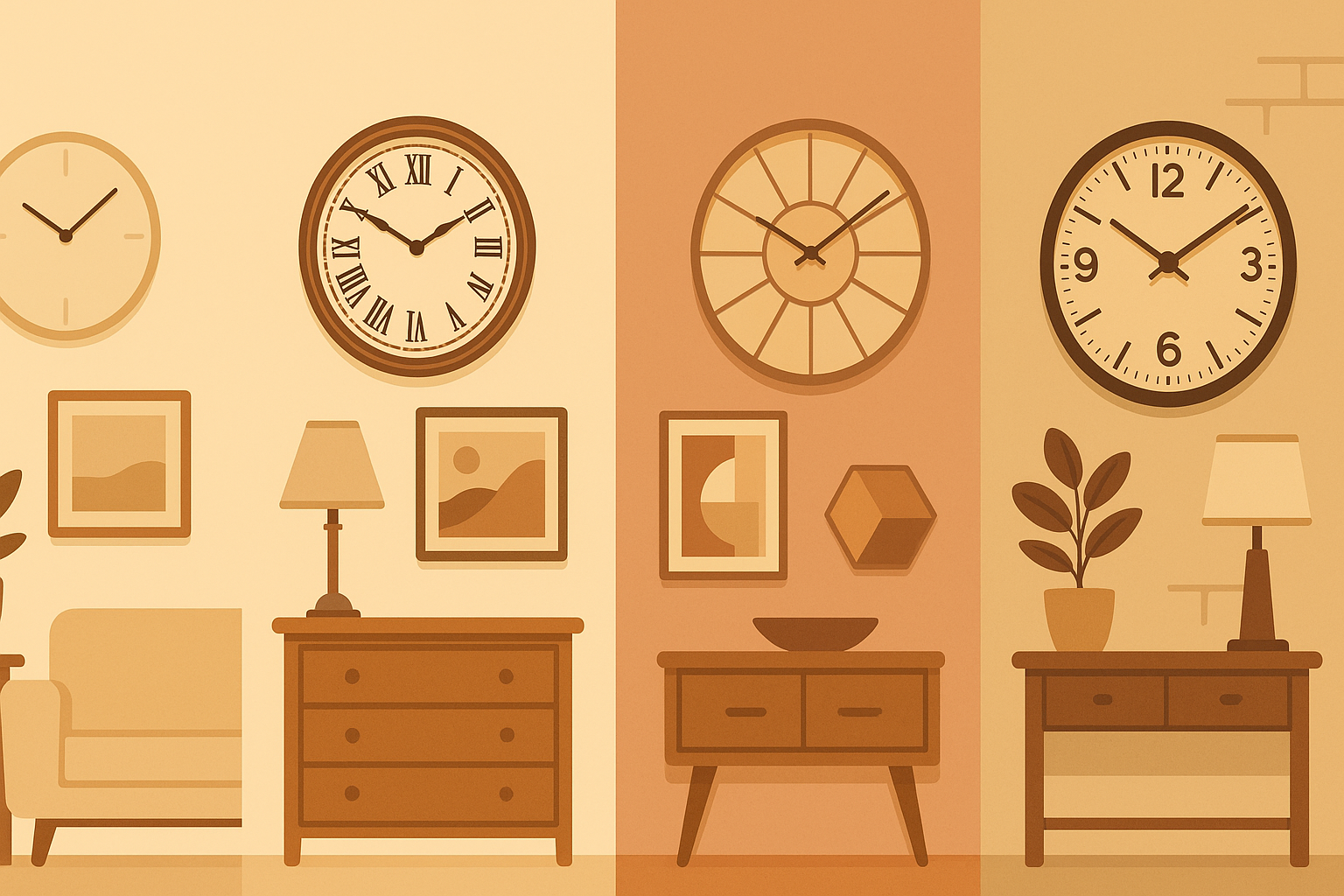
How to Choose the Perfect Clock for Your Decorating Style: 2025 Guide
Choosing a wall clock is about far more than simply telling the time. It’s about creating a focal point, adding character to your interior and expressing your personality. Honestly, I was skeptical at first when people told me a simple clock could transform a room. But after trying different styles in my own home, I can assure you that the decorative impact of a well-chosen clock is truly spectacular.
In this complete guide, we’ll explore together how to perfectly harmonize your wall clock with your existing decorating style.
Table of Contents
- Different clock styles to match your décor
- Colors and materials: the keys to harmony
- Strategic sizes and placement
- Choosing by room
- Mistakes to avoid at all costs
- Frequently asked questions
Different Clock Styles to Match Your Décor
The Modern Clock for a Contemporary Interior
For a contemporary decorating style, go for a modern wall clock with clean lines. These models favor simplicity and elegance. Honestly, who hasn’t been seduced by those minimalist designs that seem to float on the wall?
The characteristics of a modern clock:
- Materials: brushed metal, glass, acrylic
- Colors: black, white, anthracite grey
- Design: straight lines, geometric shapes
- Dial: often bare, stylized numerals
The Vintage Clock for Retro Charm
Vintage wall clocks instantly add character to your interior. I installed a Roman numeral clock in my dining room last year, and the effect is striking. It tells a story.
Here’s what defines the vintage style:
- Finishes: patinated, artificially aged
- Numerals: Roman or antique Arabic
- Colors: warm tones, beiges, creams
- Materials: solid wood, oxidized metal
The Industrial Clock for an Urban Look
The industrial style captivates with its raw authenticity. An industrial wall clock instantly transforms the atmosphere of a room. It evokes old factories with irresistible charm.
| Characteristic | Industrial Clock | Modern Clock | Vintage Clock |
|---|---|---|---|
| Primary material | Raw metal, wrought iron | Smooth metal, glass | Wood, patinated metal |
| Dominant color | Black, rust, grey | White, black, chrome | Beige, cream, brown |
| Atmosphere created | Urban, authentic | Clean, zen | Warm, nostalgic |
The Scandinavian Clock for Nordic Simplicity
The Scandinavian style prioritizes functionality and understated beauty. These light wood clocks bring warmth and serenity. Perfect for creating that highly sought-after hygge atmosphere.
Colors and Materials: The Keys to Harmony
Harmonizing Colors with Your Décor
The golden rule? Your clock must speak to your existing décor. If your walls are colorful, go for a clock in neutral tones. Conversely, on a white wall, dare to go bold with color!
Here are my practical tips for clock colors:
- Neutral tones (white, grey, black): work with everything
- Warm colors (beige, brown, gold): create a welcoming feel
- Cool colors (blue, green, grey): calm the space
- Bold colors: only as an accent on a neutral wall
Choosing Materials to Suit Your Interior
Each clock material carries its own energy. Wood warms, metal structures, glass lightens. Personally, I have a weakness for wood-metal combinations that create a perfect balance.
Strategic Sizes and Placement
What Size Wall Clock Should You Choose?
The size of your wall clock depends on the available space and the effect you’re after. A large wall clock automatically becomes the focal point of your room.
Size guide by space:
- 20–30 cm: kitchen, bathroom, office
- 30–50 cm: bedroom, hallway, small spaces
- 50–80 cm: living room, dining room
- Over 80 cm: large spaces, spectacular effect
The Art of Perfect Placement
Where you place your clock determines its visual impact. Rule number one: it must be visible without effort from the main living areas of the room.
Choosing by Room
The Living Room Clock: The Centerpiece
In the living room, your clock can make a statement! This is where it fully expresses your style. I went for a giant industrial clock above my sofa, and the wow factor is guaranteed with every visit.
The Kitchen: Functionality and Style
In the kitchen, prioritize legibility and moisture resistance. A modern metal clock or a vintage enameled version works wonderfully.
The Bedroom: Discretion and Harmony
In the bedroom, go for a silent clock. The ticking can become irritating at night. Quartz movement models are perfect for this.
Mistakes to Avoid at All Costs
After years of experience, here are the classic pitfalls:
- Choosing the wrong size: too small, it goes unnoticed; too large, it overwhelms the space
- Neglecting material harmony: your clock must speak to your furniture
- Forgetting functionality: prioritizing design at the expense of legibility
- Poor clock placement: too high, too low, or hidden behind a piece of furniture
One last thing: treat yourself! Your clock should move you every time you look at it. That’s the secret to a successful choice.
Frequently Asked Questions
What clock should I choose for a modern living room?
For a modern living room, go for a clock with clean lines in metal or glass. Minimalist models with a bare dial and stylized hands integrate perfectly. Favor neutral colors such as black, white or chrome.
How do I harmonize a vintage clock with my contemporary décor?
A vintage clock can fit perfectly into a contemporary setting by creating an interesting contrast. Choose a model in neutral tones and place it on a clean, uncluttered wall. The mix-and-match effect adds character without overwhelming the space.
What size clock for a 3-meter wall?
For a 3-meter wall, a clock measuring 60 to 80 cm will be well-proportioned. This size creates optimal visual impact without overwhelming the space. If the wall is very open, you can even dare to go with an oversized clock of more than 80 cm.
Does an industrial clock suit all interiors?
The industrial clock adapts to many styles thanks to its authentic character. It works perfectly with the loft, contemporary and even Scandinavian styles. Avoid it in very classic or romantic interiors where it could clash.
How do I choose between an analog and a digital clock?
Analog clocks are more decorative and timeless, perfect for style. Digital models are more practical and modern, ideal for offices or kitchens. It all depends on your priority: aesthetics or pure functionality.
Can you mix several clock styles in the same home?
Absolutely! You can have an industrial clock in the living room and a Scandinavian version in the kitchen. The important thing is to respect the harmony within each individual room and avoid mixing styles within the same visual space.