
The History of Wall Clocks

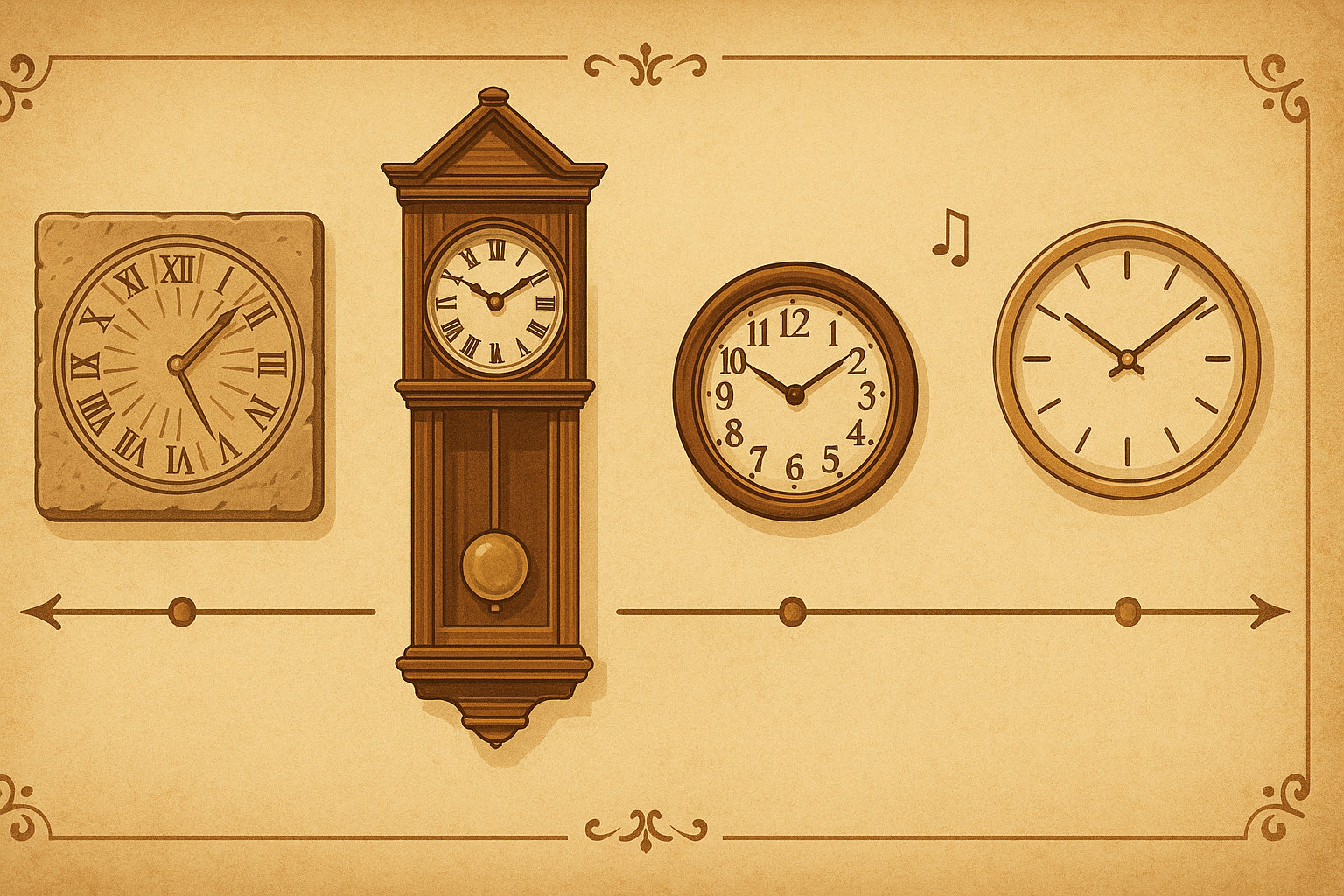
The Fascinating History of Wall Clocks: From Antiquity to the Present Day
Honestly, who hasn’t looked up at a wall clock and wondered where this fascinating invention came from? As a history enthusiast and collector of antique clocks since my art history studies, I have always been captivated by the evolution of wall clocks. These silent guardians of time have a far richer history than one might imagine.
The history of wall clocks takes us on an extraordinary journey through civilizations, revealing how humanity domesticated time. From the first Egyptian sundials to today’s connected clocks, each era has brought its own revolutionary innovations.
Table of Contents
- Ancient Origins: The First Steps Toward Measuring Time
- The Middle Ages: The Mechanical Revolution
- The Renaissance and the Age of Enlightenment: The Era of Precision
- The Industrial Revolution: The Democratization of the Wall Clock
- The Modern Era: Electricity and Innovation
- Contemporary Clocks: Design and Technology
- The Societal Impact of Wall Clocks
- Frequently Asked Questions
Ancient Origins: The First Steps Toward Measuring Time
The adventure begins over 6,000 years ago. Honestly, I was skeptical when I discovered that the Egyptians were already using gnomons around 4000 BC! These first wall sundials were far more sophisticated than one might think.
Ancient civilizations developed several ingenious systems:
- Egyptian obelisks: true giant clocks whose shadow indicated the time
- Greek sundials: the first portable timekeeping instruments
- Clepsydras: water clocks capable of measuring time even at night
- Sand clocks: ancestors of our modern hourglasses
The Innovation of the Gnomon
The gnomon, that simple vertically planted rod, revolutionized our relationship with time. The Babylonians perfected this system around 2000 BC, creating the first true graduated dials. Who would have thought that a simple shadow could change the course of history?
| Period | Civilization | Innovation | Accuracy |
|---|---|---|---|
| 4000 BC | Egyptians | First gnomons | ± 1 hour |
| 2000 BC | Babylonians | Graduated dials | ± 30 minutes |
| 1500 BC | Egyptians | Wall clepsydras | ± 15 minutes |
| 300 BC | Greeks | Hemispherical dials | ± 10 minutes |
The Middle Ages: The Mechanical Revolution
The 13th century marks a decisive turning point in the history of wall clocks. The invention of the mechanical clock around 1280 changes everything. I was fortunate enough to visit several European cathedrals where these first mechanical marvels are still running!
The Golden Age of Monastic Clockmaking
Monks, true pioneers of ancient horology, developed the first weight-driven clocks. These revolutionary systems used gravity as an energy source. The foliot mechanism, that primitive oscillating bar, represented the pinnacle of technology at the time.
The main characteristics of these first mechanical wall clocks:
- Primitive escapement system regulating the fall of the weights
- Dials without hands indicating only the canonical hours
- Automatic chiming for religious services
The Renaissance and the Age of Enlightenment: The Era of Precision
Ah, the 16th century! This period particularly fascinates me. The evolution of the wall clock undergoes an extraordinary acceleration. The celebrated clockmakers of this era competed in ingenuity to create masterpieces of precision.
The Pendulum Revolution
In 1656, Christiaan Huygens revolutionized clockmaking by inventing the pendulum clock. Frankly, this innovation changes everything! Timekeeping accuracy goes from an hour per day to just a few minutes.
This invention radically transforms:
- Maritime navigation: precise determination of longitude
- The sciences: experiments requiring exact time measurement
- Society: synchronization of human activities
The Baroque Apogee
The 17th and 18th centuries saw the birth of the most beautiful wall clocks in history. The Louis XIV, Régence, and Louis XV styles transformed these utilitarian instruments into true works of art. Marquetry makers, gilders, and bronze workers competed in creativity.
The Industrial Revolution: The Democratization of the Wall Clock
The 19th century marks the entry of the wall clock into the industrial era. Honestly, this period completely transforms access to time! Mass production finally makes these marvels accessible to the middle classes.
The Victorian Era and Its Innovations
The Victorian era brings a host of remarkable innovations. Railway stations are equipped with monumental clocks, true symbols of modernity. I have always admired those imposing station clocks that set the rhythm of travelers’ lives.
| Year | Innovation | Impact | Inventor |
|---|---|---|---|
| 1840 | Improved spiral spring | Increased precision | A.L. Breguet |
| 1850 | Mechanized production | Democratization | American industry |
| 1880 | Synchronized clocks | Railway networks | Railway companies |
The Emergence of National Styles
This period saw the birth of distinctive styles by country. German Black Forest clocks, French Empire mantel clocks, American Ogee clocks… Each nation developed its own unique clockmaking identity.
The Modern Era: Electricity and Innovation
The 20th century once again upends the history of wall clocks. The arrival of the electric clock in the 1920s revolutionizes everything! No more need for daily winding, and precision reaches unprecedented levels.
The Roaring Twenties and Art Deco
The 1920s–1930s mark the pinnacle of clock design. Art Deco transforms the wall clock into a true decorative object. These bold geometric creations still adorn many vintage interiors today.
Characteristics of the Art Deco clockmaking style:
- Pure geometric lines and stylized forms
- Noble materials: lacquer, chrome, precious wood
- Innovative dials with modernist numerals
- Architectural integration into the modern home
The Post-War Period and Democratization
The Trente Glorieuses saw the production of electric wall clocks explode. Every Western household now owns its kitchen clock, its living room timepiece. This total democratization changes our daily relationship with time.
Contemporary Clocks: Design and Technology
Today, the evolution of the wall clock continues to surprise us! Digital technologies, innovative materials, minimalist designs… The modern wall clock combines aesthetics and functionality.
The Quartz Revolution
The 1970s mark the dawn of quartz clocks. This revolutionary technology offers unparalleled timekeeping accuracy at a negligible cost. Who would have imagined that a simple crystal could revolutionize clockmaking?
Contemporary Design and Minimalism
The 21st century favors simplicity. Contemporary designers are reinventing the wall clock with unexpected materials: concrete, resin, recycled materials. This ecological approach responds to today’s concerns.
Current trends in clock design:
- Scandinavian minimalism: clean lines, neutral colors
- Connected clocks: home automation integration, automatic synchronization
- Sustainable materials: bamboo, recycled materials, ethical production
- Personalization: custom-made clocks, personalized engravings
The Societal Impact of Wall Clocks
The history of wall clocks reveals their considerable influence on our societies. These instruments have literally shaped our modern civilization! Their impact goes far beyond the simple measurement of time.
Social Synchronization
Public wall clocks enabled the coordination of collective activities. Railway stations, schools, factories, offices… Wherever synchronization was crucial, the wall clock reigned supreme.
Evolution of Lifestyles
The growing accessibility of wall clocks has transformed our domestic rhythms. Meals, work, leisure… Everything is now organized around these temporal guardians. Honestly, just imagine your daily life without a clock!
| Domain | Before the Clock | After the Clock | Revolution Brought |
|---|---|---|---|
| Transport | Approximate schedules | Precise synchronization | Railway revolution |
| Work | Natural rhythm | Fixed hours | Industrial productivity |
| Education | Free-form learning | Structured lessons | Modern school system |
Frequently Asked Questions
What is the oldest preserved wall clock?
The oldest preserved mechanical wall clock dates from 1386. It is located in Salisbury Cathedral in England. This marvel of ancient horology is still running today after more than 600 years!
Who invented the first electric wall clock?
The first electric clock was developed by Alexander Bain in 1840. However, the first commercial electric wall clocks appeared around 1920, revolutionizing the evolution of the domestic wall clock.
Why were wall clocks so important in railway stations?
Station clocks synchronized train departures and arrivals. This timekeeping precision was crucial to avoid collisions and organize rail traffic. They symbolized modernity and Victorian punctuality.
How do you recognize an authentic antique wall clock?
A genuine antique wall clock displays distinctive signs: visible mechanism, markings from celebrated clockmakers, natural wear, period-appropriate materials. The expertise of a professional remains indispensable for authentication.
What is the difference between a pendulum clock and a wall clock?
Technically, a pendulum clock uses an oscillating pendulum to regulate time, while a wall clock refers to any timekeeping instrument fixed to a wall. However, in common usage, these terms are often interchangeable.
Are modern wall clocks still accurate?
Contemporary quartz wall clocks display remarkable accuracy: less than one second of deviation per day. Radio-controlled models synchronize automatically, eliminating any time drift.